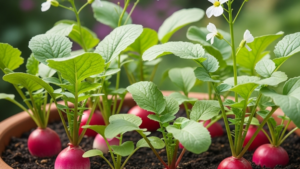
Radishes (Raphanus sativus) are the undisputed speed champions of the vegetable garden. 💨 For many gardeners, they are the first harvest of the year, offering a crisp, peppery reward just as the spring season begins. Because they grow so quickly, they are the perfect project for children, beginners, or anyone with limited space. This guide explains how to optimize your growing conditions to go from seed to salad in record-breaking time. 🥗✨
Choosing the Right Varieties for Speed 📝
Not all radishes are created equal. If your goal is a 3-week harvest, you must select varieties specifically bred for rapid growth. 🕒
- The “18-Day” Radish: This is a classic heirloom variety named for its incredible speed. It produces elongated red radishes with white tips. 📈
- Saxa or Cherry Belle: These are reliable, round red radishes that typically mature in 21 to 25 days. They are famous for staying crisp even if harvest is slightly delayed. 🍒
- French Breakfast: A mild, elongated variety that is prized for its crunch and speed, usually ready in about 20–25 days. 🥖
The Secret to Rapid Germination 🛠️
To hit the 3-week mark, you cannot afford to wait days for seeds to wake up in cold soil. You need to “jumpstart” the biological process.
- The Pre-Soak Trick: Soak your radish seeds in lukewarm water for 2 to 4 hours before planting. This softens the outer shell and tells the embryo inside that it is time to grow. 🏺💧
- Soil Temperature: Radishes germinate best when the soil is between $15^{\circ}\text{C}$ and $20^{\circ}\text{C}$. If planting early in the spring, cover your soil with black plastic for a few days prior to sowing to trap solar heat. ☀️🌡️
- Shallow Sowing: Do not bury the seeds too deep. Plant them only 1 cm deep. If they are too deep, they spend too much energy reaching the surface, which slows down the root development. 📏🌱
Ideal Soil and Spacing 💡
Radishes need a “path of least resistance” to expand quickly. If the soil is too hard, the radish will grow slowly and become misshapen.
- Light and Loose Soil: Use a mix rich in compost but free of large stones or hard clay lumps. Stones will cause the radish to split or grow crooked. 🏺✨
- Avoid High Nitrogen: Do not use heavy manure or high-nitrogen fertilizers. Excessive nitrogen tells the plant to grow massive green leaves while leaving the root tiny and thin. 🚫🥬
- Proper Spacing: Space seeds about 3–5 cm apart. If radishes are crowded, they will “bolt” (go to seed) or fail to bulb up entirely because they feel stressed by their neighbors. 🏗️📏
Maintenance: The “Crunch” Factor 🚿
The difference between a delicious radish and a woody, bitter one is almost entirely down to water management.
- Consistent Moisture: Radishes must grow “fast and without stress.” If the soil dries out, the radish becomes spicy, pithy, and tough. Water them lightly every morning to keep the soil surface cool and moist. 🚿🛡️
- Sunlight: They need at least 6 hours of full sun. In late spring, if the weather gets too hot, give them some afternoon shade to prevent them from becoming too “hot” or spicy. ☀️🛡️
- Flea Beetle Protection: These tiny black insects love radish leaves. Use a fine mesh row cover immediately after planting to protect the young leaves, ensuring the plant can photosynthesize at maximum speed. 🛡️🐛
Harvesting at the Peak ✂️
In a 3-week cycle, the harvest window is small. You must be ready to pick!
- Check Daily: Once you hit day 18, gently push the soil away from the top of the root. If it looks about 2 cm in diameter, it is ready. 🔍
- Don’t Wait: If you leave radishes in the ground too long, they become “pithy” (hollow and spongy) and lose their sweetness. 📉🚫
- The “Continuous” Method: To have radishes all season, sow a new small row every 7 to 10 days. This ensures a never-ending supply of fresh crunch! 🔄🥗
Leave a Reply