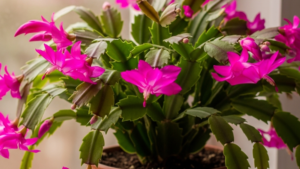
The Christmas Cactus (Schlumbergera), often known in various regions as Santa Teresita, is a stunning plant that defies most expectations of what a cactus should be. 🌵 Unlike its prickly desert cousins, this plant is a tropical epiphyte native to the lush rainforests of Brazil. 🇧🇷 It is prized for its unique, segmented leaves and its ability to produce a cascade of vibrant, exotic flowers during the darkest months of the year. In 2026, it remains one of the most popular houseplants for adding color to winter interiors, provided you understand its specific “jungle-born” needs. 🌸✨🎄
Light and Location: Finding the Tropical Sweet Spot ☀️
Because it originates from the understory of the rainforest, the Christmas Cactus has very specific light requirements.
- Avoid Direct Sun: Intense, direct midday sun will scorch the delicate segments, turning them yellow or even reddish-purple as a sign of stress. ☀️🚫
- The Perfect Exposure: Place your plant in a spot with bright, indirect light. North or east-facing windows are ideal. If you have a south-facing window, move the plant a few feet away from the glass or use a sheer curtain to filter the rays. 🌤️🏡
- Stability is Key: Once the plant begins to form flower buds, do not move it or rotate it. The Christmas Cactus is extremely sensitive to changes in light direction and may drop its buds in protest if disturbed. 🚫🏺
Watering and Humidity: The Moisture Balance 🚿
The most common mistake is treating the Christmas Cactus like a desert cactus and letting it dry out completely.
- The Finger Test: Water the plant when the top 2 cm of soil feel dry to the touch. The goal is to keep the soil consistently moist but never soggy. 💧✅
- Drainage is Vital: Ensure your pot has drainage holes. Standing water at the bottom of the pot will lead to root rot faster than almost any other factor. 🏺🚿
- High Humidity: Since it’s a rainforest plant, it thrives in humidity levels of 50-60%. 🌬️💧 You can increase humidity by:
- Misting the plant every few days.
- Placing the pot on a tray filled with pebbles and a small amount of water (ensuring the pot sits on the pebbles, not in the water).
- Grouping it with other plants to create a micro-environment. 🌿✨
Temperature and Flowering Secrets 🌡️
To get your Schlumbergera to bloom reliably every year, you must respect its biological clock, which is triggered by temperature and light changes.
- Ideal Growing Temperature: During the growing season, it prefers temperatures between $18^{\circ}\text{C}$ and $24^{\circ}\text{C}$. 📈
- The Blooming Trigger: To initiate flower buds, the plant needs a “cooling period” in the autumn. For about 6 to 8 weeks, keep the plant in a room that stays between $12^{\circ}\text{C}$ and $15^{\circ}\text{C}$. 📉❄️
- Total Darkness: Along with the cooler temperatures, the plant needs 12 to 14 hours of total darkness each night. Even the light from a streetlamp or a television can interfere with bud development. Cover the plant with a dark cloth or place it in an unused room at night. 🌑🛡️
Soil, Fertilizer, and Propagation 🧪
- The Right Soil: Use a well-draining potting mix. A blend of cactus soil mixed with 25% perlite or fine bark is perfect for providing the aeration its tropical roots crave. 🏺🪵
- Feeding for Growth: During the spring and summer, feed the plant every two weeks with a balanced liquid fertilizer. Stop fertilizing in late summer to allow the plant to enter its blooming cycle. 🧪📈
- Easy Propagation: If a segment accidentally breaks off, don’t throw it away! Let the cutting dry for 24 hours, then insert it into moist soil. In just a few weeks, it will grow its own roots, giving you a new plant to share. 🌿🎁
Maintenance After the Bloom 🌸
Once the flowers have faded, your Christmas Cactus needs a short rest. Reduce watering and stop fertilizing for about a month. In early spring, you can prune the plant by removing one or two segments from the ends of the stems. This encourages the plant to branch out, creating a fuller, more bushy shape that will produce even more flowers next year. ✂️🔋
By following this complete guide, you ensure that your “Santa Teresita” becomes a long-lived family heirloom, bringing joy and color to your home for decades to come. 🏡💖✨
Leave a Reply