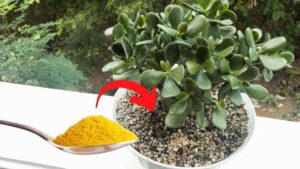
The Jade Tree (Crassula ovata), often called the “Money Tree,” is a staple in homes around the world, loved for its thick, glossy leaves and its reputation for bringing good luck. 🌳 However, for many gardeners, the ultimate challenge is not just keeping it alive, but getting it to produce its rare and beautiful star-shaped flowers. In 2026, we’ve moved past expensive synthetic boosters. The secret to a flowering Jade Tree lies in a single spoonful of a common organic ingredient: Wood Ash (or sometimes Epsom Salt, depending on your soil’s needs). 🌸✨💰
Why Your Jade Tree Refuses to Bloom 📝
To solve the problem, we first have to understand the plant’s biology. Jade trees are succulents from South Africa that thrive on a bit of “tough love.”
- Nutrient Imbalance: Most indoor fertilizers are high in Nitrogen, which is great for green leaves but actually prevents flowering. The plant needs a surge of Potassium and Phosphorus to create buds. 📉🌿
- The Age Factor: A Jade tree usually needs to be at least 3 to 4 years old before it has the biological maturity to flower. 🕰️
- The Light Gap: Without enough intensity, the plant simply doesn’t have the energy reserves to produce blooms. ☀️🚫
The Miracle Ingredient: Wood Ash 🧪
Experienced gardeners use a single spoonful of wood ash to flip the “bloom switch.”
- Potassium Powerhouse: Wood ash is naturally rich in potassium (potash), which is the primary nutrient responsible for flower development and water regulation within the plant. 🌋✨
- pH Regulation: Jade trees prefer a slightly acidic to neutral soil. Over time, potting soil can become too acidic. The alkalinity of the ash helps balance the pH, “unlocking” other minerals in the soil so the roots can finally reach them. 📈⚖️
- Magnesium and Calcium: These micronutrients strengthen the plant’s cell walls, making the stems thick and sturdy enough to hold heavy clusters of flowers. 💪🧱
How to Apply the “Spoonful” Treatment 🛠️
- The Dosage: Take one level tablespoon of fine, sifted wood ash (ensure it is from natural wood, not treated lumber or charcoal briquettes). 🥄
- The Application: Sprinkle the ash evenly over the surface of the soil, keeping it away from the direct base of the trunk to avoid “salt burn.” 🏺📍
- The Activation: Lightly scratch the ash into the top centimeter of the soil and water the plant moderately. The water will carry the minerals down to the root zone. 🚿💧
- Frequency: Perform this gesture once in early autumn and once in early winter. Over-applying ash can make the soil too alkaline, so “less is more.” 🗓️✅
The Environmental Triggers: The Finishing Touch 💡
Even with the perfect fertilizer, the Jade Tree needs two specific environmental signals to bloom:
- The Cooling Period: In late autumn, the plant needs a drop in temperature. Keep it in a room that stays around $12^{\circ}\text{C}$ to $15^{\circ}\text{C}$ at night. This “stress” tells the plant that winter is coming and it’s time to reproduce. 📉🌡️
- The Darkness Rule: Just like the Christmas Cactus, the Jade Tree needs long nights. Ensure it gets at least 12 hours of total darkness. If you keep it in a room where the lights are on until midnight, it will never form buds. 🌑🛡️
- Reduced Watering: During the two months leading up to its blooming season, cut your watering in half. This “drought stress” combined with the wood ash minerals is the ultimate trigger for those white and pink blossoms. 🚿🚫
Leave a Reply