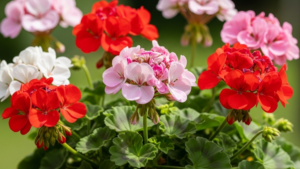
Geraniums (Pelargonium) are the undisputed champions of the balcony and garden, loved for their resilience and the explosion of color they bring to any space. 🌸 Whether you are a seasoned gardener or a total beginner, getting these plants to bloom continuously requires a specific set of care rituals. In 2026, the secret to a record-breaking floral display lies in mastering the balance between sunlight, strategic pruning, and proper hydration. Follow this complete guide to keep your geraniums healthy and vibrant through every season. 📈✨🌿
The Power of Sunlight and Placement 📝
Geraniums are essentially “sun-catchers.” Without enough light, they will stop flowering and become weak.
- The 6-Hour Rule: For maximum bloom production, geraniums need at least 6 to 8 hours of direct sunlight every day. ☀️
- Best Exposure: South or West-facing balconies and gardens are ideal. If you live in an extremely hot climate, provide a little afternoon shade to prevent the leaves from scorching during peak summer temperatures. 🌤️📉
- Airflow Matters: Never crowd your geraniums. Good air circulation is vital to prevent fungal diseases like rust and grey mold. Space your plants at least 20 cm apart. 🌬️🛡️
Strategic Watering: Avoiding the “Drowning” Trap 🚿
More geraniums are killed by overwatering than by drought. Their semi-succulent stems are designed to store water.
- The Dry-Touch Method: Only water when the top 3 cm of soil feels completely dry. If the soil is still damp, wait another day. 💧🚫
- Water the Soil, Not the Leaves: Aim your watering can at the base of the plant. Getting the leaves wet creates a humid environment that encourages fungal infections and leaf spots. 🚿🛡️
- Drainage is Non-Negotiable: Ensure your pots have plenty of holes. Standing water at the bottom of a container will cause root rot almost overnight. 🏺✅
Soil Quality and Feeding for Flowers 🧪
Because geraniums are such prolific bloomers, they are “heavy feeders” that quickly deplete the nutrients in their soil.
- The Right Substrate: Use a light, well-draining potting mix. Adding a bit of sand or perlite can help improve drainage and keep the roots oxygenated. 🏺✨
- Potassium and Phosphorus Boost: To keep the flowers coming, use a liquid organic fertilizer every two weeks during the spring and summer. Look for a mix high in Potassium ($K$), which is the primary fuel for flower development. 🧪🌸
- Avoid High Nitrogen: Fertilizers too high in Nitrogen will give you a massive green bush but very few actual flowers. 📈🚫🌿
Maintenance: Deadheading and Pruning ✂️
To enjoy a “vibrant bloom all year round,” you must actively manage the plant’s energy.
- The Deadheading Gesture: This is the most important task. As soon as a flower cluster begins to fade and turn brown, snap off the entire stalk at its base. This tells the plant to stop wasting energy on seeds and start producing new buds. ✂️🔋
- Spring Pruning: In early spring, prune your geraniums by about one-third. This encourages “lateral branching,” resulting in a bushier plant with more points for flowers to grow. 🌿✨
- Yellow Leaf Removal: Periodically remove any yellow or dead leaves from the base to keep the plant clean and prevent pests from hiding in the debris. 🧽🛡️
Overwintering and Pest Control ❄️🛡️
If you live in a climate with frost, you must protect your geraniums to see them bloom again next year.
- Winter Rest: Bring your plants indoors before the first frost. Keep them in a cool ($10^{\circ}\text{C}$ to $15^{\circ}\text{C}$), bright room. Reduce watering to the bare minimum—just enough to keep the stems from shriveling. 📉🌡️
- Common Pests: Watch out for aphids and whiteflies. A simple spray of water mixed with a little bit of potassium soap (black soap) is usually enough to keep these pests away without using harsh chemicals. 🦋🚫
By following this guide, you respect the biological needs of the geranium, transforming it from a simple plant into a non-stop flower machine that will brighten your home for years to come. 🏡🌸✨
Leave a Reply