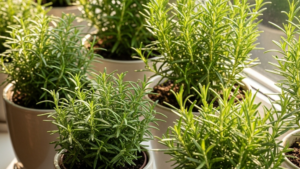
Rosemary (Salvia rosmarinus) is a Mediterranean treasure prized for its pine-like aroma, culinary versatility, and needle-like evergreen leaves. 🌿 In 2026, indoor herb gardening has become a staple for urban dwellers looking to bring freshness and aromatherapy into their kitchens. While rosemary is a hardy shrub in the wild, growing it successfully on a windowsill requires a specific approach to mimic its rocky, sun-drenched coastal origins. This guide provides everything you need to keep your potted rosemary thriving year-round. 📈✨🥗
The Sunlight Requirement: The 6-Hour Rule 📝
Rosemary is a “solar-powered” plant. Without enough light, it will quickly become spindly, lose its scent, and eventually succumb to root rot or powdery mildew.
- Direct Exposure: Your windowsill must receive at least 6 to 8 hours of direct sunlight daily. A south-facing window is the gold standard, while a west-facing window is a good second choice. ☀️
- Winter Strategy: During the shorter days of winter, the natural light may not be enough. Consider placing your pot under a small LED grow light for a few hours in the evening to keep its energy levels high. 💡📉
- Rotation: Every week, rotate the pot by 90 degrees. This ensures that all sides of the plant receive equal light, preventing it from leaning too far toward the glass. ☀️🔄
Choosing the Right Pot and Soil 🛠️
The container you choose is critical for the plant’s health. Unlike most houseplants, rosemary hates “wet feet.”
- The Terracotta Advantage: Professional gardeners recommend terracotta pots over plastic or glazed ceramic. Terracotta is porous, allowing moisture to evaporate through the sides, which helps prevent the soil from staying too damp. 🏺✨
- Drainage is Vital: Ensure the pot has a large drainage hole at the bottom. Never let the pot sit in a saucer full of standing water. 🚿🚫
- Sandy Soil Mix: Use a well-draining potting mix. A blend of 60% standard potting soil and 40% coarse sand or perlite is ideal. This replicates the sandy, rocky soil of the Mediterranean coast where rosemary naturally flourishes. 🧪🏜️
The “Dry Feet” Watering Method 🚿
Watering is the most common place where indoor rosemary owners fail. Overwatering is the #1 killer of this herb.
- The Finger Test: Only water when the top 3 to 5 cm of soil feels completely dry to the touch. When you do water, soak it thoroughly until water runs out of the drainage hole. 💧✅
- Foliage Misting: While the roots hate being wet, the leaves appreciate a little humidity, especially in dry, heated apartments. Give your plant a gentle misting once a week or place a small bowl of water near the pot to increase the ambient humidity. 🌬️💧
- Winter Rest: In the winter months, rosemary grows much slower and requires significantly less water. Reduce your frequency and always check the soil before adding more. ❄️📉
Air Circulation and Temperature 🌬️
Rosemary is used to the breezy Mediterranean coast and hates stagnant, still air.
- The Airflow Trick: If your rosemary is in a crowded corner, it may develop powdery mildew (a white, flour-like fungus on the leaves). Ensure there is space around the pot for air to move. Opening a window slightly on a mild day can work wonders. 🌬️🌀
- Temperature Prefers: It thrives in temperatures between $15^{\circ}\text{C}$ and $22^{\circ}\text{C}$. Keep it away from direct heat sources like radiators or heaters, which can dry out the needles too quickly. 🌡️🛡️
Pruning and Harvesting for Growth ✂️🔋
Don’t be afraid to use your rosemary! Regular harvesting actually makes the plant healthier and bushier.
- Never Take Too Much: Never harvest more than one-third of the plant at once. 📏
- Tip Sniping: Snip the tips of the branches regularly. This encourages the plant to branch out laterally rather than growing one long, thin stalk. ✂️🌿
- Bottom Up: Avoid removing all the leaves from the bottom of a branch. Always leave some green needles to allow that section of the stem to continue photosynthesizing. 🔋✨
By following these simple steps, you can enjoy the “living pantry” of fresh rosemary on your windowsill, perfect for roasting potatoes, seasoning meats, or simply enjoying the refreshing scent every time you walk by. 🏡🌸✨
Leave a Reply