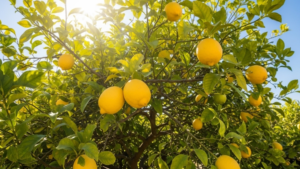
There is nothing quite like the refreshing scent of citrus blossoms or the sight of bright yellow fruit hanging from a branch to bring a touch of the Mediterranean to your home. 🍋 In 2026, lemon trees (Citrus limon) have become one of the most popular functional ornaments for patios and bright indoor spaces. However, because they are “productive” plants, they require a specific energy balance to transition from just growing leaves to producing heavy harvests. This guide covers the essential biological pillars to keep your lemon tree thriving and flowering throughout the seasons. 📈✨🌿
Sunlight: The Solar Engine for Your Citrus 📝
Lemon trees are literal solar-powered factories. To produce the sugars necessary for fruit development, they need massive amounts of energy.
- The 8-Hour Rule: Your tree needs at least 8 hours of direct sunlight daily. A south-facing position is non-negotiable for success. ☀️
- Indoor Challenges: If you keep your tree indoors, place it in the brightest window possible. In 2026, if your natural light is low during winter, using a full-spectrum LED grow light for 4 hours a day can prevent leaf drop and keep the tree in “production mode.” 💡📊
- Acclimatization: When moving your tree outdoors in the spring, do it gradually over 10 days to avoid “sunburn” on the leaves. 🌤️🛡️
Watering: The Art of Consistency 🚿
The most common cause of lemon tree failure is improper watering. They are very sensitive to both “drought stress” and “wet feet.”
- The “Two-Knuckle” Rule: Stick your finger into the soil. If it is dry up to your second knuckle (about 3–5 cm), it is time to water. 💧✅
- Deep Hydration: When you water, do it thoroughly until water runs out of the drainage holes. This ensures the entire root ball is hydrated and flushes out any accumulated salts from fertilizers. 🏺🚿
- Drainage: Citrus roots need oxygen just as much as water. Ensure your pot has excellent drainage and never let the tree sit in a saucer filled with stagnant water, which triggers root rot almost instantly. 🚫🌊
Feeding the “Greedy” Lemon Tree 🧪
Lemon trees are known as “heavy feeders” because they are constantly working to produce leaves, flowers, and fruit simultaneously. 🔋
- High-Nitrogen Growth: In the spring, use a fertilizer high in Nitrogen ($N$) to support lush green growth. 🌿📈
- Potassium for Fruit: Once you see flower buds, switch to a fertilizer higher in Potassium ($K$). This improves the size, juice content, and sweetness of the lemons. 🍋✨
- Micro-Nutrient Jolt: Citruses often suffer from iron or magnesium deficiencies (shown by yellow leaves with green veins). Adding a spoonful of Epsom salt or a chelated iron supplement once a month can correct this “anemia” and keep the tree vibrant. 🧪🛡️
Pruning and Airflow: Shape Matters ✂️🔋
Pruning is not just about aesthetics; it is about energy management and disease prevention.
- Center Clearing: Prune away branches that grow toward the center of the tree. This opens up the “heart” of the plant to sunlight and increases airflow, which prevents pests like scale and spider mites from moving in. 🌬️🌀
- Sucker Removal: Watch for fast-growing, thorny stems emerging from the very base of the tree (below the graft line). These are “suckers” that steal energy from the productive part of the tree. Cut them off immediately! ✂️🚫
- The 45-Degree Cut: Always prune at a 45-degree angle to prevent water from sitting on the cut, which can lead to fungal infections. 🔪✅
Winter Care and Protection ❄️🏠
Unless you live in a tropical climate, winter is the most dangerous time for your lemon tree.
- The Temperature Threshold: Lemon trees start to suffer when temperatures drop below $10^{\circ}\text{C}$. Bring potted trees indoors before the first frost hits. 🌡️📉
- Humidity Management: Indoor heating is very dry, which causes lemon trees to drop their leaves in panic. Use a humidifier or mist the tree daily to keep the leaves hydrated while the roots are in their “slow” winter phase. 🌬️💧
- Stop Fertilizing: During the darkest months, the tree enters a semi-dormant state. Stop feeding it until you see the first signs of new green growth in late February or March. 🛑🗓️
By mastering these pillars, you provide your lemon tree with the stability it needs to reward you with fragrant blossoms and a bountiful harvest year after year. 🏡🍋✨
Leave a Reply