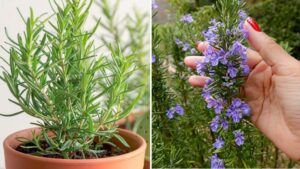
In 2026, rosemary (Salvia rosmarinus) is celebrated not just as a culinary herb, but as a biological air purifier and ornamental centerpiece. 🌿 While most people are familiar with its needle-like leaves, few have experienced the beauty of its delicate blue or purple flowers, which release an even more intense, resinous aroma. Getting rosemary to bloom indoors or in a garden requires mimicking its native Mediterranean habitat. By understanding the plant’s biological “stress signals” and light requirements, you can transform a simple shrub into a flowering aromatic bouquet. 📈✨🌸
The Biological Triggers for Rosemary Flowering 📝
Rosemary is a hardy perennial that needs specific environmental cues to move from vegetative growth to reproductive (flowering) growth.
- The Vernalization Effect: In nature, rosemary blooms after a period of cooler temperatures. This “winter chill” signals the plant that spring is approaching. To trigger blooms, the plant needs to experience temperatures between 5°C and 12°C for several weeks. 🌡️📉
- Photoperiodism: Rosemary requires high-intensity light. It needs at least 6 to 8 hours of direct sunlight to produce the energy required for the metabolic shift into flowering. ☀️🔋
- Strategic Neglect: Paradoxically, rosemary blooms best when it feels slightly “threatened.” Over-fertilizing with nitrogen promotes lush green leaves but prevents flowers. 🧪🚫🌿
The Three Pillars of a Flowering Rosemary 🛠️🏺
- Soil and Drainage: Rosemary is a “dry-feet” plant. Its roots are highly susceptible to fungal rot if kept in soggy soil. Use a mix of 70% potting soil and 30% sand or perlite. In 2026, adding a handful of crushed limestone or eggshells is a popular biological hack to keep the soil slightly alkaline, which rosemary loves. 🏺🏜️
- Watering Discipline: Allow the top 5 cm of soil to dry out completely between waterings. When rosemary feels a slight drought, it triggers a survival instinct to reproduce (bloom). 🚿🛡️
- Pruning for Airflow: Prune the tips of the plant in early spring. This removes the “apical dominance” and encourages the growth of lateral branches where flowers typically form. ✂️✨
How to Maximize the Scent 💡
- Avoid Humidity: Unlike tropical plants, rosemary hates humid air. Keep it in a well-ventilated room. Dry air helps concentrate the essential oils (alpha-pinene and cineole) in the leaves and flowers. 🌬️👃
- The Heat Kick: Once buds appear, moving the plant to a slightly warmer, sunnier spot will accelerate the opening of the flowers and increase the scent dispersion throughout your home. ☀️🌡️
Leave a Reply