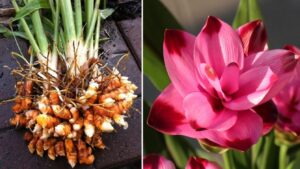
In 2026, turmeric (Curcuma longa) has become the ultimate “wellness plant” for home gardeners. 🌿 Known primarily for its golden, anti-inflammatory rhizomes, this tropical beauty is also prized for its spectacular foliage and exotic white-and-pink flowers. Growing turmeric in a pot is a rewarding biological project that provides you with a fresh supply of curcumin-rich spice while acting as a stunning ornamental piece. Because it requires a long growing season and high humidity, the controlled environment of a container is often the best way to guarantee success. 📈✨🥗
Selecting the Perfect Rhizome 📝
Your journey begins with the selection of a healthy “seed” rhizome.
- The Sprout Check: Look for organic turmeric roots that have small, knobby protrusions (buds). These are the biological growth points. If they are already showing green tips, your plant will emerge much faster. 🔍🌱
- The “Eye” Rule: If you are cutting a large root into smaller pieces, ensure each section has at least two or three “eyes” (buds). ✂️🛡️
- The Callous Phase: After cutting, let the pieces dry for 24 hours. This creates a protective seal that prevents the root from rotting once it hits the moist soil. 🛡️⏳
The Potting and Growth Protocol 🛠️🏺
- Container Choice: Turmeric grows horizontally. Choose a wide, rectangular, or circular pot at least 30 cm deep and 40 cm wide. 🏺📏
- Soil Matrix: Use a light, fertile potting mix enriched with plenty of organic compost. Turmeric is a “heavy feeder” that requires a constant supply of nutrients to build its underground tubers. 🧪🌿
- Planting Depth: Place the rhizomes about 5 cm deep with the buds facing upward. Space them roughly 15 cm apart. ⚓🌱
- Heat and Light: Turmeric is a tropical survivor. It needs a warm spot with filtered light (it hates harsh, direct noon sun) and a temperature consistently above 20°C. ☀️🌡️
Maintenance for Lush Blooms 💡
- The Humidity Secret: To trigger those rare, beautiful flowers, you must mimic the jungle. Mist the leaves daily or place the pot on a tray of wet pebbles. High humidity is the biological signal for the plant to start its reproductive (flowering) phase. 🌬️💦
- Watering Strategy: Keep the soil consistently moist but never soggy. During the peak summer growth, the plant will drink heavily to support its large, broad leaves. 🚿🛡️
- The Harvest Cycle: Turmeric takes about 8 to 10 months to mature. When the leaves begin to turn yellow and dry out, it’s the plant’s signal that the energy has moved entirely into the rhizomes. Dig up the entire plant, save a few roots for next year, and enjoy the rest fresh! ✂️🏺
Leave a Reply