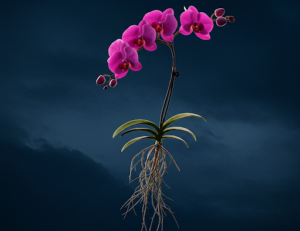
In 2026, losing the root system of an orchid due to overwatering or infection is no longer a death sentence for the plant. 🌸 Orchids are incredibly resilient biological organisms capable of regenerating their vascular systems if given the right hormonal signals and environment. The “Emergency Recovery” method focuses on high-humidity resuscitation and the use of natural growth stimulants like garlic or honey. By creating a controlled “micro-greenhouse,” you can trigger the plant’s survival instinct to produce new air roots within weeks. 📈✨🌿
The Biological Challenge: Survival Without Roots 📝
When an orchid loses its roots, it can no longer absorb water or nutrients, leading to shriveled, leathery leaves.
- Dehydration Defense: The plant begins to consume its own internal water reserves stored in the leaves. To save it, you must stop this evaporation by providing 100% ambient humidity. 🌬️💦
- The Root Signal: Without a root tip to produce growth hormones (auxins), the plant needs an external biological “kick” to restart the cellular division required for new root tissue. 🧪🧬
- Pathogen Control: The area where roots were lost is an open wound. It must be sterilized to prevent systemic rot from traveling up into the crown. 🛡️🦠
The Step-by-Step Recovery Protocol 🛠️🏺
- Cleaning and Sterilization: Remove all mushy, black, or dried-out roots using sterilized scissors. Clean the base of the plant (the “neck”) with a cotton swab dipped in cinnamon powder or a diluted garlic solution to kill fungi. ✂️🧄
- The Energy Boost: Soak the base of the orchid in a solution of 1 teaspoon of honey per 500ml of water for 30 minutes. Honey contains natural enzymes and sugars that provide the plant with a quick energy source for cell regeneration. 🍯⚡
- The Moss “Nest”: Place the orchid in a small transparent container filled with slightly damp Sphagnum moss. Do not bury the neck; the plant should just rest on top of the moss. 🌿🏺
- The Micro-Greenhouse: Cover the entire container with a clear plastic bag or a cut plastic bottle to trap humidity. Place it in a warm spot with bright, indirect light. ☀️🏠
- Ventilation: Open the “greenhouse” for 10 minutes every day to exchange the air and prevent mold growth. 🌬️✅
Signals of Success 💡
- Leaf Firmness: The first sign of recovery is the leaves stopping their decline and becoming firmer to the touch. 🍃📈
- Green “Nubs”: Within 3 to 6 weeks, you should see tiny, bright green protrusions emerging from the base of the neck. These are the new primordial roots. 🔍🌱
- When to Repot: Wait until the new roots are at least 5 cm long before transitioning the plant back into traditional orchid bark. ⚓🏗️
Leave a Reply