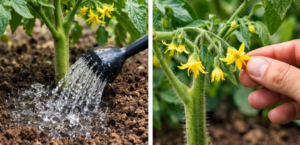
June is the make-or-break month for tomato growers. As the first yellow blossoms appear, the plant’s nutritional needs shift dramatically from growing green leaves to producing fruit. If the plant lacks specific minerals or faces environmental stress now, the blossoms will drop, and your yield will plummet. By following these three essential steps in June, you ensure that every flower turns into a healthy, juicy tomato.
The Three Pillars of June Tomato Care
1. Feeding for Fruit, Not Foliage
Once flowers appear, stop using high-nitrogen fertilizers, which only encourage more leaves. Instead, switch to a fertilizer rich in Potassium and Phosphorus.
- The Potassium Boost: Potassium is responsible for fruit quality and sugar content. A simple homemade solution is to use wood ash or a specialized liquid seaweed fertilizer.
- The Boron Secret: Many professional growers use a very diluted boric acid spray (2g per 10 liters of water) during flowering. Boron helps the “set” of the fruit, ensuring that flowers don’t fall off prematurely. 🧪🌸
2. Manual Pollination Support
In June, the air can sometimes be too still, or humidity can be too high, causing pollen to stick inside the flower.
- The Shake Technique: Every morning, gently vibrate or tap the flower clusters or the support stakes. This mimics the vibration of a bee’s wings and ensures the pollen falls where it needs to go. 🐝✨
- Airflow: Ensure you have removed the lower leaves to allow air to circulate freely around the flowers, which also prevents fungal diseases.
3. Systematic Pruning (Removing Suckers)
June is the peak time for “suckers”—those small shoots that grow in the V-shape between the main stem and a leaf.
- Energy Management: These suckers drain energy away from the developing fruit. Remove them while they are small (less than 5 cm) to keep the plant’s energy focused on the main fruit clusters. ✂️📈
Important Watering Rules for June
As the heat increases in June, the soil must stay consistently moist. Fluctuations in moisture lead to “blossom end rot” (black spots on the bottom of the fruit) because the plant cannot transport calcium properly.
- Tip: Water early in the morning and only at the base of the plant. Avoid getting the leaves wet to prevent blight. 🚿☀️
Leave a Reply