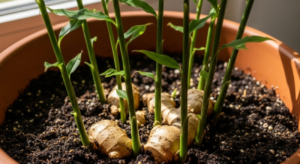
Ginger (Zingiber officinale) doesn’t grow from traditional seeds but from its rhizome (the root part we eat). Because the ginger you buy at the store is often treated with a growth inhibitor to keep it from sprouting on the shelf, the “secret” to success lies in the preparation phase. Once you “wake up” the root, it becomes a fast-growing, beautiful plant that looks like a miniature bamboo and provides you with endless fresh spice.
The 3 Simple Steps to Start Your Ginger Garden
1. The “Awakening” Soak
The ginger found in supermarkets is often sprayed to stay dormant.
- The Method: Soak your ginger root in warm water overnight. This washes away any growth inhibitors and hydrates the “eyes” (the small pointed bumps on the root). 🏺💧
2. Choosing the Right Piece
Look for a piece of ginger that is plump and has visible, light-colored “nodes” or “eyes” that look like they want to sprout.
- Pro Tip: You can cut the ginger into smaller pieces to grow multiple plants, but make sure each piece is at least 3–5 cm long and has at least two healthy eyes. Let the cut pieces dry for 24 hours before planting to prevent rot. 🌱✨
3. Shallow Planting
Ginger grows horizontally, not vertically. This means you need a wide, shallow pot rather than a deep one.
- The Technique: Place the ginger on top of a rich potting mix with the eyes pointing upward. Cover it with only 2–3 cm of soil. Do not bury it deep, or the new sprouts will struggle to reach the light. 🏺📈
Essential Care for Beginners
- The “Warm & Wet” Rule: Ginger is a tropical plant. It loves warmth ($20\text{–}30^{\circ}\text{C}$) and soil that is consistently moist but not “soupy.” Never let the soil dry out completely. 🌡️🚿
- Light Preference: Unlike many vegetables, ginger doesn’t need harsh, direct sunlight. It thrives in filtered light or partial shade, making it an excellent indoor plant for a bright room. ☀️🛡️
- The Harvest: You can start “robbing” the plant (cutting off small pieces of root for cooking) after about 4 months. For a full harvest, wait until the leaves turn yellow and die back (usually after 8–10 months).
Leave a Reply