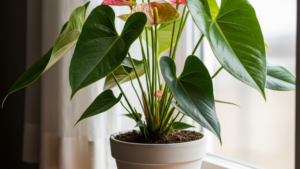
Anthuriums, also known as Flamingo Flowers, are among the most striking indoor plants in 2026, prized for their waxy, heart-shaped “flowers” (which are actually specialized leaves called spathes). 🌸 While they have a reputation for being “divas,” they are remarkably resilient if you mimic their natural habitat in the tropical rainforests of Central and South America. Even if you’ve never kept a plant alive before, these strategic tips will help your Anthurium thrive, grow faster, and bloom year-round. 📈✨🌿
The Secret of Tropical Light 📝
The most common mistake beginners make is placing an Anthurium in a dark corner or under the scorching direct sun.
- Bright Indirect Light: Imagine the filtered light on a jungle floor. Your plant needs a spot near a window with a sheer curtain. This provides the energy for blooming without burning the glossy leaves. ☀️🛡️
- The “Leggy” Warning: If your plant starts growing long, thin stems and stops producing red spathes, it is telling you it’s too dark. Move it closer to a light source immediately. 📉🌑
Mastering the Epiphytic Soil Mix 🛠️
In the wild, many Anthuriums grow on trees (epiphytes) rather than in the ground. Their roots crave oxygen. 🌬️
- No Heavy Garden Soil: Standard potting soil is too dense and will suffocate the roots. 🚫🏺
- The “Chunk” Method: Use a mix of 50% orchid bark, 25% perlite, and 25% peat moss. This creates large air pockets, allowing the roots to “breathe” and preventing the dreaded root rot. 🪵🧪✨
Watering and the Humidity Factor 🚿
Anthuriums love water, but they hate “wet feet.” 💧🚫
- The Finger Test: Only water when the top 2-3 cm of soil is dry. When you do water, soak it thoroughly until liquid drains from the bottom, then empty the saucer. 🏺🚿
- The 60% Humidity Rule: These plants suffer in dry, air-conditioned rooms. To keep the leaves from turning brown at the tips:
- Group your plants together to create a micro-climate. 🌿🌿
- Place the pot on a tray of pebbles filled with water (ensure the pot sits above the water). 🌬️💧
- Give the leaves a gentle misting every morning. 🚿✨
Feeding for Constant Color 🧪
Since Anthuriums can bloom all year long, they need a steady supply of nutrients. 🔋
- Phosphorus is Key: Use a liquid fertilizer with a higher middle number (Phosphorus) once a month during the spring and summer. This specifically fuels the production of those iconic red spathes. 🧪🌸
- Dilution Secret: Always dilute your fertilizer to half-strength. Anthurium roots are sensitive to salt buildup and can “burn” if the chemicals are too concentrated. 📈🛡️
The “Clean Leaf” Protocol 💡
Because Anthurium leaves are so large and waxy, they act as dust magnets. 🧽
- Wipe Regularly: Dust blocks the pores (stomata) and prevents the plant from photosynthesizing effectively. Once a week, wipe the leaves with a damp, soft cloth. 🍃✨
- No Leaf Shine: Avoid commercial “leaf shine” sprays. These contain oils that can clog the plant’s pores. A little bit of water is all you need for that natural, mirror-like glow. 🚫🧼
Troubleshooting Common Issues 🔍
- Yellow Leaves: Usually a sign of overwatering. Check the roots for mushiness. 🍂🚿
- Brown, Crunchy Edges: A sign of low humidity or chemical burn from tap water. Try using filtered water or rainwater instead. 🌧️🛡️
- Slow Growth: Ensure the temperature stays between $18^{\circ}\text{C}$ and $27^{\circ}\text{C}$. They hate cold drafts from windows or air conditioners. 📉🌡️
By following these simple environmental adjustments, you transform your home into a tropical paradise where your Anthurium will flourish for years to come. 🏡🌸✨
Leave a Reply