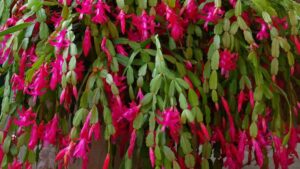
In 2026, the Christmas Cactus (Schlumbergera) is no longer seen as a temperamental plant, but as a biological clock that can be mastered with precision. 🌸 Many gardeners struggle with plants that only produce green segments, but the secret to a massive explosion of blooms lies in the “Stress and Acidify” technique. By manipulating environmental signals and soil chemistry, you can force the plant to move from its vegetative phase into a heavy reproductive cycle. This guide reveals the professional method to ensure every stem is heavy with vibrant flowers. 📈✨🌿
The Biological “Bloom Signal” 📝
Christmas cacti are epiphytes from the humid forests of Brazil. They bloom in response to specific environmental pressures that signal the change of seasons.
- The Dark Trigger: This is a “short-day” plant. It requires 12 to 14 hours of continuous, total darkness per day for at least 6 weeks to develop buds. Even a stray streetlamp or a hallway light can disrupt this biological countdown. 🌑⏳
- Thermal Stress: A drop in temperature to between 10°C and 15°C is the second half of the flowering signal. Without this “cool shock,” the plant will remain in a growth state rather than a flowering state. 🌡️📉
- Acidification for Energy: In the wild, these plants grow on trees where decaying organic matter keeps the pH low. Forcing the soil to be slightly acidic (pH 5.5) allows the plant to absorb the massive amounts of potassium needed for flower production. 🧪⚡
The “Acidic Rinse” Method 🛠️🏺
- The Formula: Mix 1 tablespoon of organic Apple Cider Vinegar or fresh lemon juice with 2 liters of water. 🏺💧
- The Application: Starting in mid-autumn, replace your regular watering with this acidic solution once every three weeks. This clears mineral buildup around the roots and “unlocks” dormant nutrients. 🚿🛡️
- Potassium Boost: During the 6-week “darkness” period, use a fertilizer high in potassium and phosphorus (0-10-10) to provide the raw materials for bud expansion. 🧪✨
Essential Care for Bud Retention 💡
- Zero Movement: Once you see tiny buds (the size of a pinhead), do not move or rotate the pot. Any change in light orientation causes the plant to produce abscisic acid, which results in “bud drop.” 🏗️🚫
- Humidity Mimicry: While the plant needs cool air, it also needs high humidity. Place the pot on a tray of wet pebbles to prevent the dry indoor heat from shriveling the developing buds. 🌬️💦
- The Post-Bloom Pruning: After the flowers fade, prune the stems by 2-3 segments. This triggers lateral branching, creating twice as many points for flowers to grow next season. ✂️📈
Leave a Reply